Find us here
Web Application Security: Meeting the Strict Standards of Government Institutions

Admin
Why Web Application Security Is More Critical Than Ever
Imagine a public service portal being compromised within minutes, exposing millions of citizens' personal records to cybercriminals and dark web marketplaces.
For government agencies, state-owned enterprises, and enterprise organizations, this scenario is not a hypothetical risk—it is a constant threat in today's digital environment.
Organizations invest billions of rupiah in digital transformation initiatives, yet those investments can be rendered worthless if cybersecurity is not prioritized from the earliest stages of system development.
This is why implementing government-standard web application security is no longer optional. Data protection is not simply an additional feature—it is the foundation of institutional credibility, operational resilience, and public trust.
Why Traditional Firewall Protection Is No Longer Enough
Modern cyberattacks have evolved significantly.
Threat actors now leverage artificial intelligence, automation, and sophisticated attack frameworks capable of bypassing conventional security controls. Distributed Denial-of-Service (DDoS) attacks, database manipulation attempts, credential theft, and application-layer exploits occur on a massive scale every day.
Government organizations and enterprise businesses require security systems that go beyond basic perimeter defense.
Modern infrastructures must be capable of detecting suspicious behavior, identifying anomalies, and responding proactively before a breach can be successfully executed.
As a result, enterprise-grade systems should be developed in accordance with internationally recognized security frameworks such as ISO 27001, as well as cybersecurity guidelines established by national authorities including Indonesia's National Cyber and Crypto Agency (BSSN).
Business Analogy: A National Bank Vault vs. an Office Desk Drawer
Consider the difference between storing classified documents inside a wooden office drawer and securing them inside the vault of a national central bank.
A public-facing portal protected only by basic security measures resembles the office drawer. With enough determination and the right tools, unauthorized parties can gain access relatively easily.
A government-grade security architecture, however, functions like a high-security banking vault.
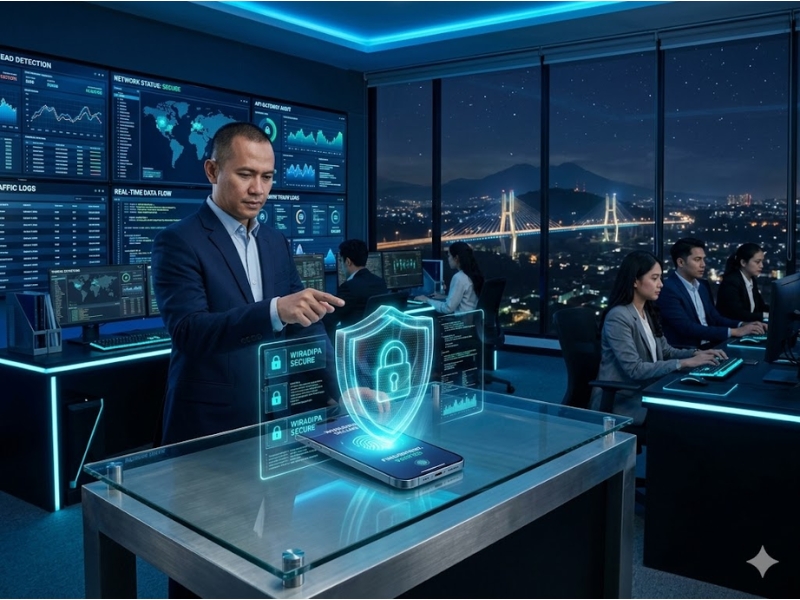
Multiple layers of encryption, biometric controls, intelligent monitoring systems, and around-the-clock threat detection work together to protect valuable assets from unauthorized access.
This is the level of protection modern institutions should expect from their digital infrastructure.
Compliance with Indonesia’s Personal Data Protection Law (PDP Law)
The implementation of Indonesia’s Personal Data Protection Law (PDP Law) has significantly increased accountability for organizations that collect, process, and store personal information.
Data controllers are now expected to maintain robust security practices and demonstrate responsible data governance.
Failure to implement adequate safeguards can result in severe regulatory consequences, financial penalties, legal disputes, and reputational damage.
For this reason, enterprise-grade web applications should adopt a Privacy by Design approach.
Security requirements must be integrated directly into the architectural blueprint of the system long before software development begins. Protection should be embedded into every layer of the application lifecycle rather than added as an afterthought.
Core Components of a Government-Grade Security Infrastructure
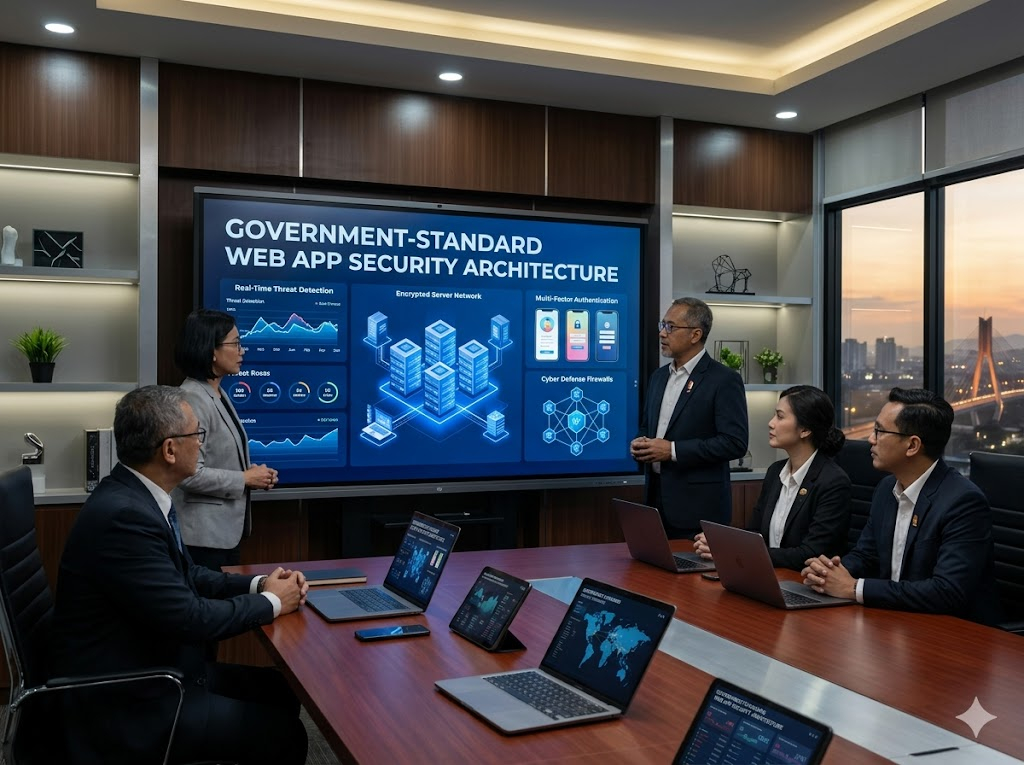
Achieving the level of protection required by government institutions and enterprise organizations requires a layered security strategy.
The following components form the foundation of a resilient web application security framework:
End-to-End Encryption (E2EE)
Protects sensitive information by encrypting data during transmission between users and servers, preventing interception and unauthorized access.
Multi-Factor Authentication (MFA)
Strengthens access control by requiring users to verify their identity through multiple authentication methods, such as passwords, authentication applications, or security tokens.
Advanced Web Application Firewall (WAF)
Proactively blocks malicious traffic, application-layer attacks, SQL injection attempts, cross-site scripting (XSS), and other common cybersecurity threats.
Cryptographic Session Management
Automatically monitors user sessions and terminates suspicious activities when anomalies such as unusual login patterns or unauthorized access attempts are detected.
Continuous Monitoring and Threat Detection
Provides real-time visibility into security events, enabling organizations to identify, investigate, and respond to threats before they escalate into major incidents.
Choosing an Enterprise-Grade Technology Partner
Entrusting a large-scale digital transformation project to an IT provider without proven security expertise can expose your organization to significant operational and regulatory risks.
You need a secure web application development partner with a deep understanding of cybersecurity best practices, enterprise architecture, and Indonesia’s evolving data protection regulations.
Every software component should undergo rigorous penetration testing, vulnerability assessments, and continuous security reviews throughout its lifecycle.
Through our Enterprise Website and Application Development services, Wiradipa Nusantara places security at the center of every project.
Secure Your Digital Future with Wiradipa Nusantara
At Wiradipa Nusantara, our engineering team combines advanced cybersecurity practices, enterprise-grade infrastructure design, and regulatory compliance into a comprehensive security strategy.
We build web applications that remain resilient against evolving cyber threats while meeting the strict operational requirements of government institutions, state-owned enterprises, and large corporations.
Our approach ensures that your digital systems stay one step ahead of attackers while maintaining the trust of users, stakeholders, and regulators.
Protecting user data is not only a technical responsibility—it is a strategic commitment to preserving institutional integrity and long-term credibility.
Contact Wiradipa Nusantara today to schedule an IT security architecture consultation and safeguard your organization’s digital assets for the future.
Recent Articles


Featured Articles









































.jpg)